Specially Controlled Industrial Waste Manager
Hazardous wastes are defined as “Specially Controlled Wastes” in the Waste Management and public cleansing Law (hereinafter “Law”) in Japan. The Specially Control Wastes include waste oil, waste acid (pH≦2.0), waste alkali (pH≧12.5), infectious waste, PCB waste, waste asbestos, and wastes that exceed the judging criteria for heavy metals, organic chloride solvents, pesticides, and others.
The Law also requires allocating a qualified manager for a business premise discharging specially controlled wastes, and stipulates his/her role as follows:
1) Knowing the status of the Specially Controlled Wastes discharged in his/her business premise,
2) Planning for the proper management of his/her wastes,
3) Accomplishing proper management of his/her wastes according the Commission Standard of the Law including the issue of the Industrial Wastes Control Manifest,and
4) Submitting required reports to the Governor or the Mayer concerned.
To do the above role, the qualified manager is to have sufficient knowledge and expertise as the Table below shows.
Table: Qualifications for the Specially Controlled Industrial Waste Manager
| Official certificates (professions, educational background, etc.) | Years engaged |
|---|---|
| A. Specially controlled industrial waste (except infectious industrial waste) generating site | |
| 1. Environmental sanitation supervisor specified by the law | ≧ 2 years |
| 2. University education in science, pharmacy, engineering or agriculture | ≧ 2 – 3 years |
| 3. Junior college education in science, pharmacy, engineering or agriculture | ≧ 4 - 5 years |
| 4. Senior high school education in science, engineering or agriculture | ≧ 6 - 7 years |
| 5. Practical experience of technical work related to waste disposal. | ≧10 years |
| 6. Judge to equivalent to or superior to specified in 1 to 5 | Non |
| B. Infectious industrial waste generating site | |
| 1. Medical doctor, dentist, pharmacist, veterinarian, public health nurse, midwife, nurse, clinical test engineer, hygienic test engineer or dental hygienist | Non |
| 2. Environmental sanitation supervisor specified by the law | ≧ 2 years |
| 3. Education of medicine, pharmacy, public health, hygiene or veterinary at university or technical college | Non |
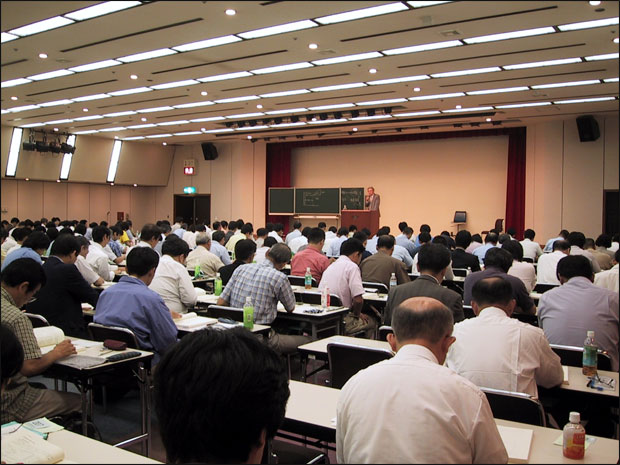
The JW has provided a training session for the Specially Controlled Industrial Waste Manager since 1993. The certification is issued when the applicants pass the examination implemented after the training lectures. The session is also opened to the qualified managers who want to brush up their knowledge and expertise. Up to now, more than 320 thousand persons in total have applied for the session.
Photo: Participants Attending the Training Session of JW